

- This event has passed.
Flameworkers Discuss the Making and Transporting of the Blaschka Collection
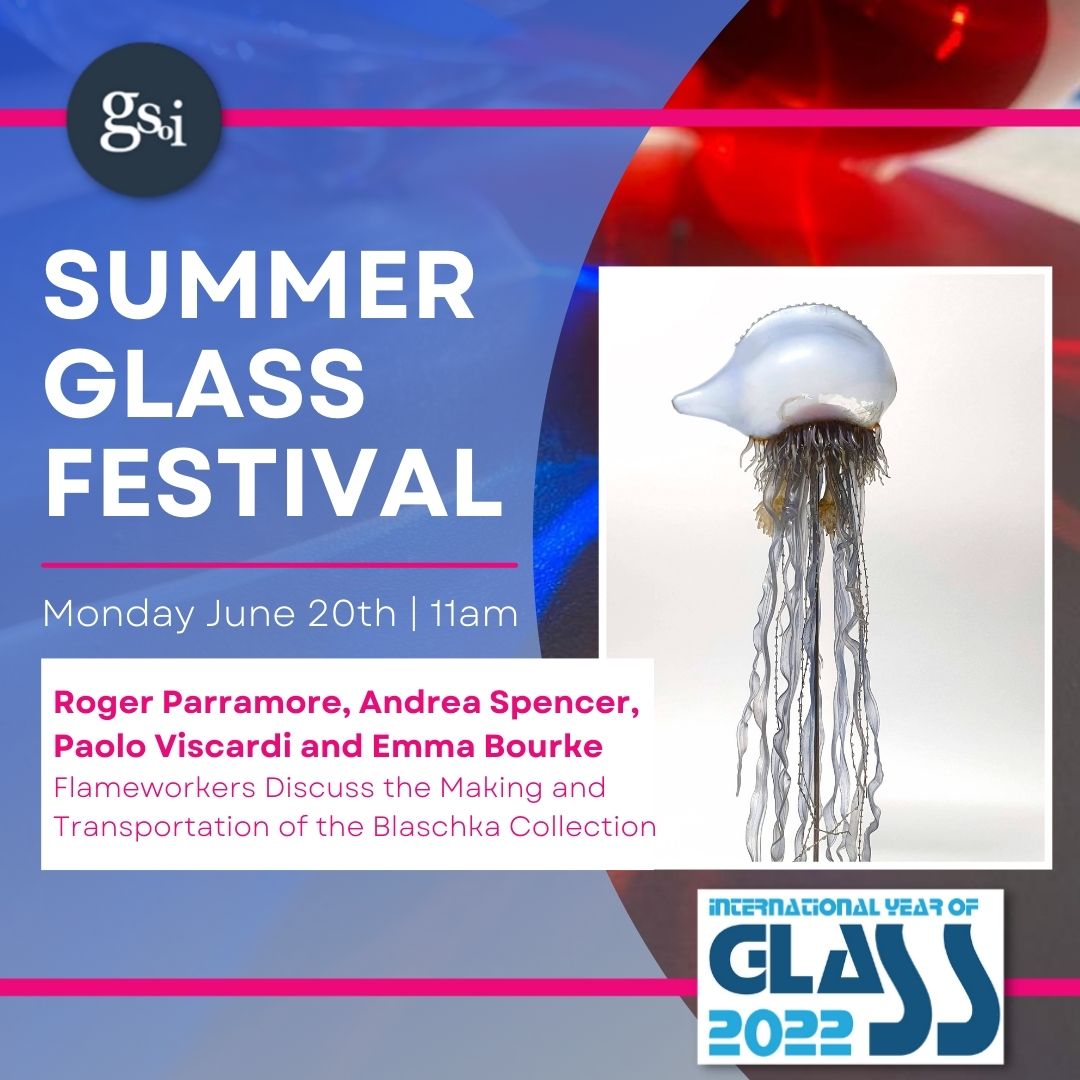
Roger Parramore, Andrea Spencer & Emma Bourke, with Paolo Viscardi discussing the making & global transportation of the Blaschka collection
About this event
Paolo Viscardi is a senior curator at the National Museum of Ireland – Natural History (NMINH). His background is in the natural sciences and museology and he has over 17 years’ professional experience of working with natural history collections in the UK and Ireland. As part of his varied role, he manages the NMINH collection of Blaschka models of invertebrate animals, which is one of the largest of its kind in the world.
Roger Parramore has been working with glass since he was 10 years old. His early experience with a home-built furnace led to formal training as a scientific glassblower, working with major scientific companies, national universities and Nasa. Parramore’s current work at the flame, using hand techniques, reflect his fascination with the form and romance of traditional Italian glassware. The origins of flameworking in Germany is also a point of interest and has led to extensive explorations of the traditional blown Christmas bauble.
Roger Parramore’s experience with chemistry and physics led him to a fascination with glassblowing as a process, and also glass as a material. As a result, he founded the Parramore Color Company which manufactures colored glasses for borosilicate lampworking. He lives and works in North Carolina
Andrea Spencer graduated from Edinburgh College of Art in 1993 with a BA (Hons) in Architectural Glass. Her small-scale sculpture and site-specific installations are concept driven, exploring natural forms to create artworks that carry a personal narrative.
Spencer maintains an emphasis on the unique properties of glass, exploiting the qualities of transparency, fragility and fluidity intrinsic to the material and employs techniques to encapsulate, contain and protect, alongside elements to define, brace, bridge and support.
Andrea’s work is held in significant public and private collections, has been exhibited in the UK, Europe, USA and China and since 2008 has regularly featured in the British Glass Biennale. Her work has been included in the Corning Museum of Glass’ annual New Glass Review (2010). In 2017 she received the Arts Council of Northern Ireland Artist Career Enhancement Scheme Award. Residencies include artist-in-residence at North Lands Creative Glass (Scotland). Teaching includes national and international glass schools such as Pilchuck Glass School (USA) Bildwerk (Germany) and The Royal College of Art.
Emma Bourke graduated from NCAD with BA(Hons) in Craft Design Glass in 2009. She went on to achieve a Masters in Fine Art from the University of Sunderland in 2013. Emma has exhibited in numerous solo and group exhibitions internationally including; Portfolio at the Coach House in Dublin Castle, IRL, The Ireland Newfoundland Trail, NL Crafts Council Gallery, NL, Sociolect at The Biscuit Factory, UK.
Emma Bourke’s studio is a sea of tiny, colourful leaves, petals and other plant parts. While researching the famous glassmakers Leopold and Rudolf Blaschka, Emma discovered they built their scientific models in sections. This how she now works, painstakingly creating hundreds of miniature components before assembling them into a finished piece. Her work speaks of folklore and cultural identity, exploring the concept of biophilia: the innate human tendency to seek connections with nature.
Event Information
This event is intended as an open forum discussion panel. Contemporary flameworkers will discuss the Blaschka collection in terms of today’s world, and look at what we can learn from what we know of their methods to compare our work practices today. The Blaschkas were a father and son team of Dresden-based lampworkers, who created exquisite models of marine invertebrates between 1864 and 1890. These models were sold by mail order to museums and universities all over the world, relying on boats and railways for their distribution. The models were based on illustrations in scientific publications, and the methods used to transform these 2D images into lifelike 3D models evolved over time. Here we discuss some of the materials and methods used by the Blaschkas to both create and distribute their delicate models. We also consider the implications of this to the ongoing care and conservation of the large collection housed in the historic exhibition building of the National Museum of Ireland – Natural History.