|
|
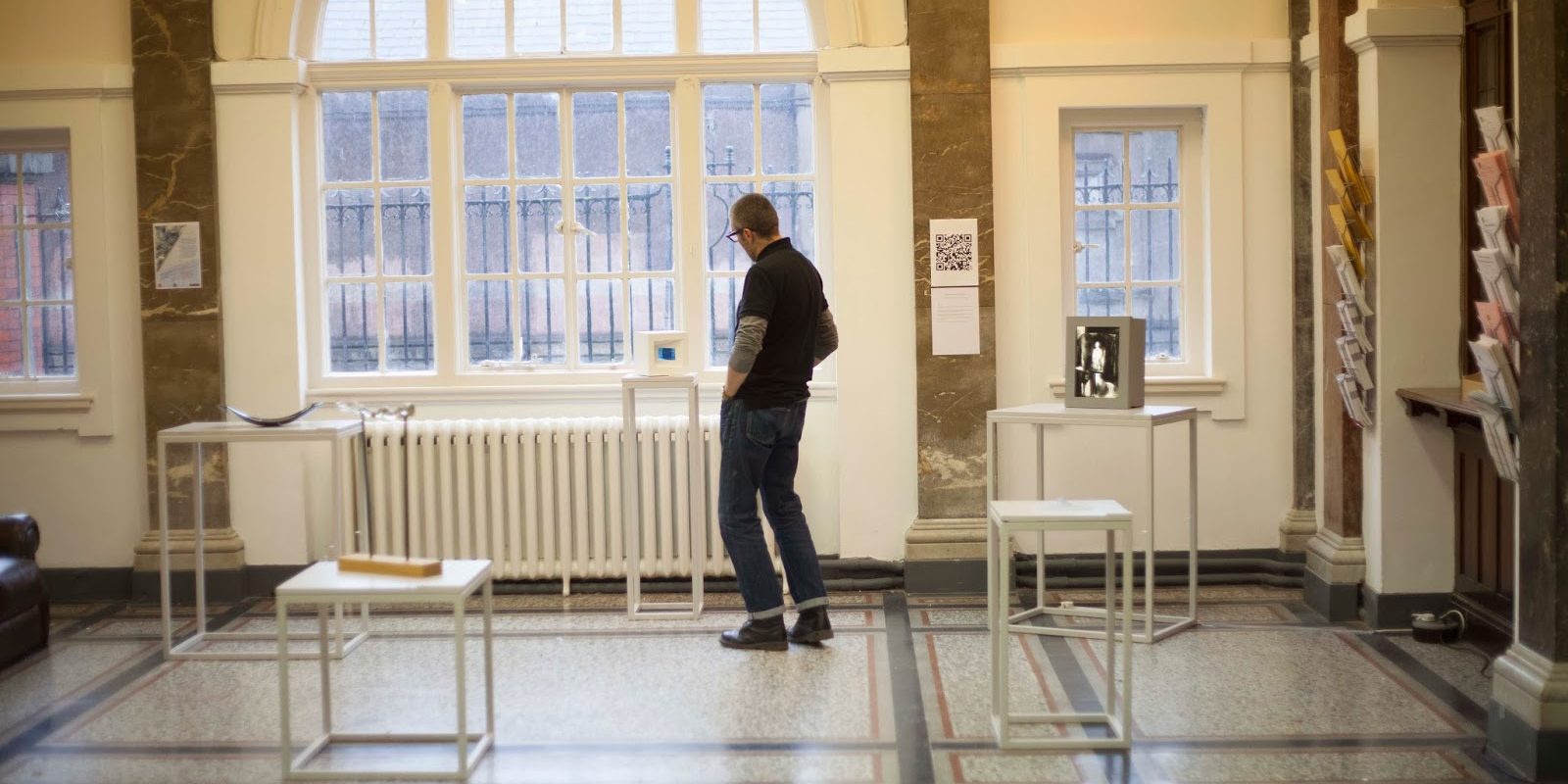
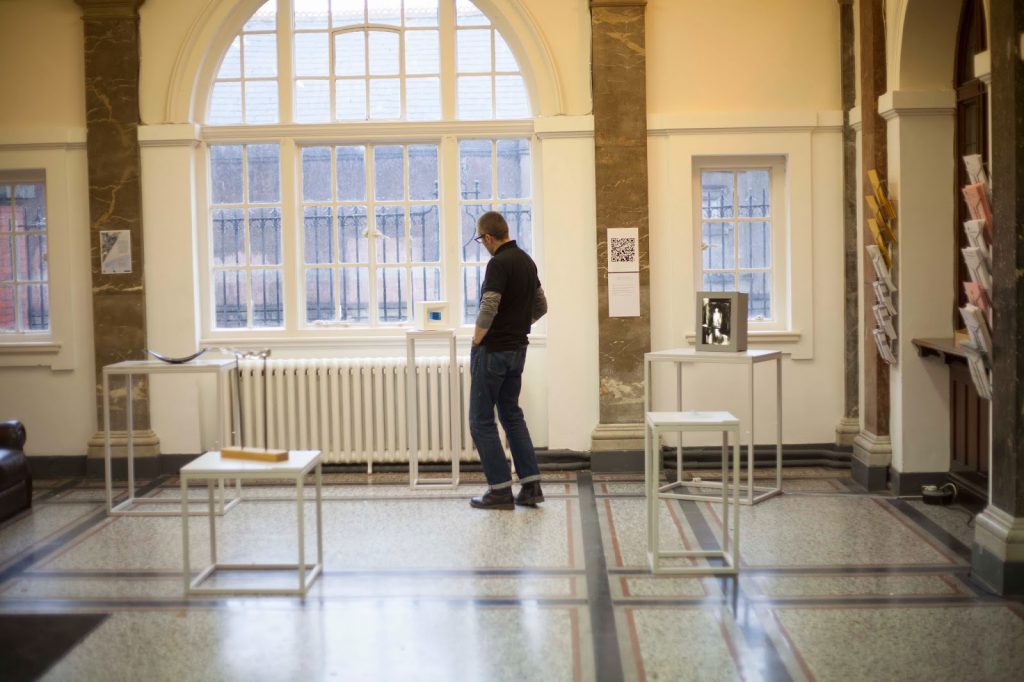
| the auction exhibition in CIT Crawford College foyer (photo Michael Holly, 2013) |
recently re-formed Glass Society of Ireland held its first international
symposium; ‘Orientate’ in CIT Crawford College of Art and Design,
Cork. Early that morning our favourite GSoI
members (I joke, we have no favourites – we just hope even more of
you can make it next year) sacrificed their Saturday lie-in to join us for a
day of stimulating talks and presentations from a variety of glass
practitioners, craft writers and curators.

fields amongst our speakers was deliberate. We are acutely aware that the
future of glass as an art material relies upon much more than a talented
artists working alone in a studio. Everyone is connected by a vital network of
dependency – the artists, the writer, the curator, the buyer. The symposium ‘Orientate’
was aptly titled; this conference aimed to
uncover how contextualising the material has underpinned glass as an occupation
– exploring how we orientate ourselves around the material.
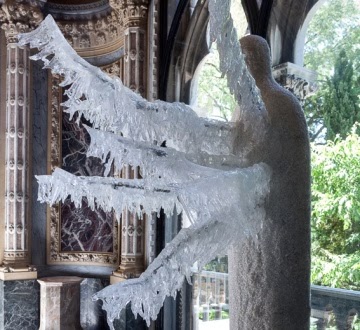 |
| Mimmo Paladino: El Rabdomante, Glasstress 2013 |
Our first speaker that morning was our keynote speaker Dr
Francesca Giubilei. We asked Francesca to give the keynote address
as she is Project Manager and Curators Assistant for the pioneering Glasstress exhibition. Glasstress, a satellite
exhibition of the world renowned Venice
Biennale, seeks to open up the use of glass as a material by giving
artists access to the incredible skills and expertise of Murano’s glass-masters
to produce work.
origins of Glasstress, a project she described as ‘a bridge between the
old idea of glass and the future.’ Projects like Glasstress are breaking
down the perception of glass as a disciplined craft material and injecting it
into the ‘anything’s possible’ world of contemporary fine art. Francesca’s
lecture really set the tone about the pivotal point that glass is at today. The
Glasstress exhibition 2013 was on show in Venice until the 24th
of November and will travel to the London College of Fashion next year.
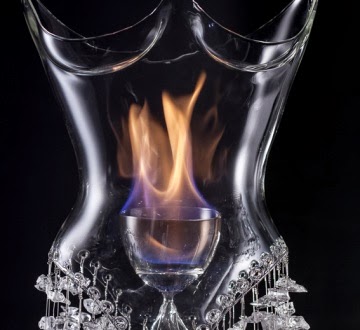 |
| Helen Story: The Dress of Glass and Flame, Glasstress 2013 |
questions and converse. An interesting discussion arose from the audience about
the importance of ‘intellectual property’ when a glass-master is involved in
the production of an artwork. Do projects like Glasstress undermine the
technical skills and achievements of the glass-masters? Many of the makers
present in the audience felt slightly uncomfortable with the idea that this
style of a conceptually led project might be the way forward for glass. While
everyone seemed to agree that the collaborations and exchange of knowledge
occurring in Venice are exciting there also seemed to be a consensus that ‘we
must not just train thinkers’ and that technical skills must not lose their
value.
Dr Eleanor Flegg. Eleanor is a writer and lecturer. Craft is her
main inspiration although as she informed us, she does not consider herself ‘a
champion to the cause of craft’ she writes about it because she finds it
interesting. Eleanor’s talk was a personal favourite: though it had very little
to do with glass, it had everything to do with the potential of writing to
explore all kinds of art/objects. She talked about the different types of
writing that may be used in the context of writing about craft – how it is
often indulgent writing, focusing on promoting the artist/gallery/material or
bland information based around dates locations and statistics about the piece
or person in question. Critical writing is less common but is something that
perhaps should be considered more since, Eleanor pointed out, “the reason that
I write at all is to find out what I think.” Our thoughts and opinions are rarely
straightforward; the reflective process of writing can help us assess them more
clearly. She referred to writing as “a making process – it’s just not three
dimensional”. Eleanor is interested in finding new ways of writing about craft
and she is currently writing a speculative fiction novel based on her
experience of a ceramic artist’s work (the name eludes me, I apologise). She
delighted us by reading an extract from it during her talk – it was the most
unusual way of engaging with an object I’ve encountered and
strangely captivating.
A central point of Eleanor’s talk left lingering
in my mind was the idea that we should be ‘pushing boundaries without being
certain of the results’. She is pushing boundaries in her atypical craft
writing practice just as exhibitions like Glasstress push boundaries and
break material tradition. If the audience – who were largely makers and
students – were to take just one thing away from her talk I hope it’s an
appreciation of the power of writing as a tool towards understanding our own
opinion and perhaps our own practice in a way that is just that little bit more
considered and – no pun intended, crafted.
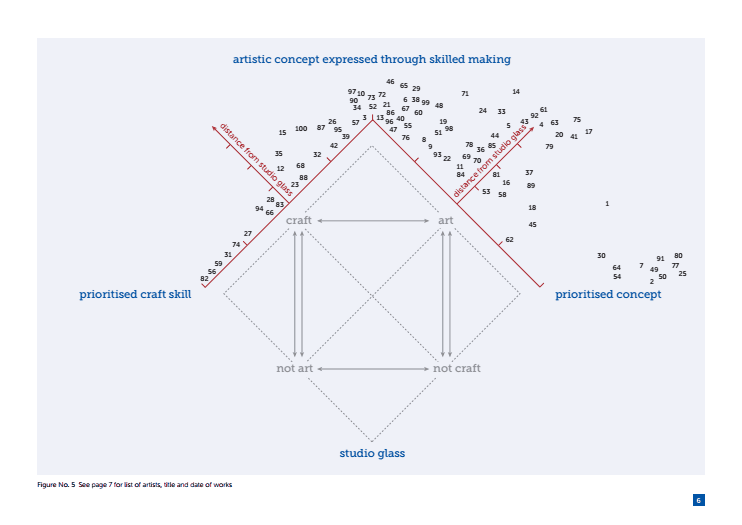 |
| Jerome Harrington, ‘Glass in the Expanded Field’ – Diagram. |
The third speaker of the morning was Jerome Harrington. Jerome is a UK artist with a background in glass making whose current
work takes an ‘expanded’ view of working with glass. He is not so much interested
in working with the material itself as investigating how it is culturally
perceived and utilized. Jerome broke his talk into 3 loose sections,
based around the questions ‘why glass?’, ‘what is glass?’ and ‘what does glass
mean?’. One of Jerome’s most interesting projects the audience found was his
2011 study of Glass in the Expanded Field. Based on Rosalind Krauss’s exploration of the expanded field of
sculpture in the 1960s, Glass in the Expanded Field is a study of how
glass makers identify themselves and their peers within the discipline:
subjects orientated themselves on a diagram in proximity to either
‘prioritising of craft skill’ or ‘prioritising of concept’. The results of the
study show a wide range of stances by makers as to where they position
themselves in relation to the studio glass movement, to craft practice and to
fine art.
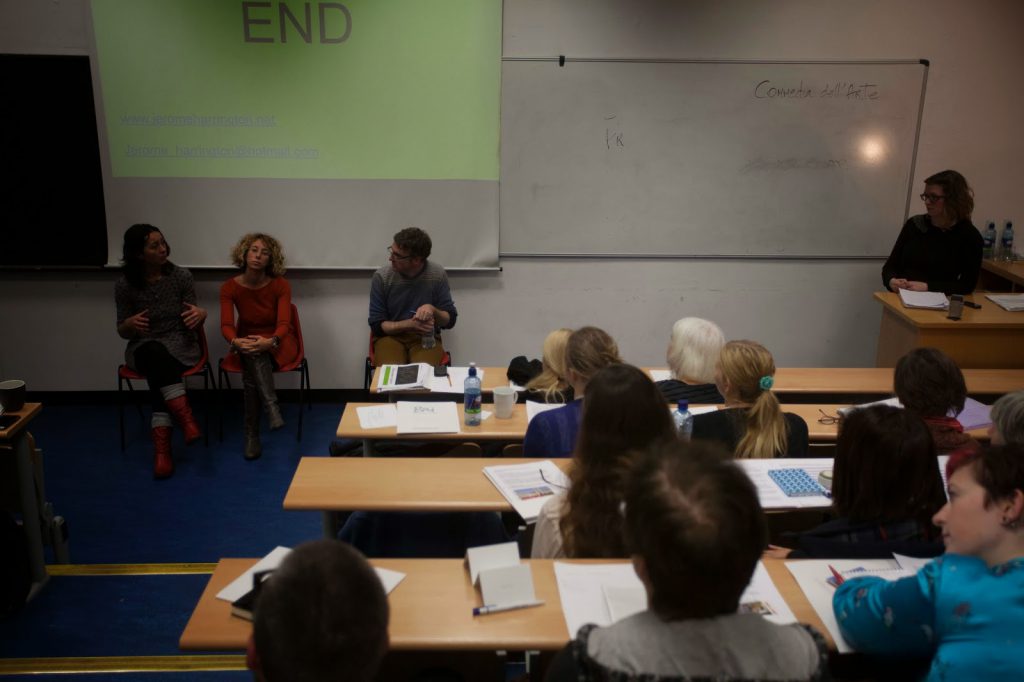 |
| Emer Lynch and our panel of speakers (photo Michael Holly 2013) |
three speakers and led by GSoI Vice-Chairperson Emer Lynch, a curator whose
own practice has developed from her educational background in glass at the National
College of Art and Design. Emer invited the audience to engage with the
speakers and ask questions on issues raised in their lectures. The main subject
that was discussed was the difference between glass art and glass craft, and if
indeed there was a difference at all. The apparent consensus within the audience
was that the labels are generally nothing more than ‘marketing categories’ and
that in general the discussion is one that makers can become fixated with but
the general public don’t particularly care about the distinction. Everyone in
the audience seemed interested in the debate and I imagine that if time allowed
we might have continued to pick the speakers brains all afternoon but time
waits for no one and it was off to a delicious lunch of home-made curry,
courtesy of the college canteen. Yum!
Written by Meadhbh McIlgorm
GSoI Media and Communications Officer