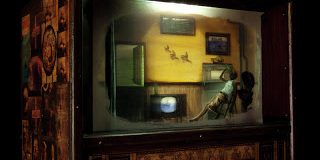

Jeff Zimmer’s background in acting retains
a strong influence over his work. The series, Theatres of Glass (2010-2011) is an obvious offshoot, but even the newest works from the whitewash series feel like a scene, set for action. After completing a Bachelor of Arts in Theatre Studies, Zimmer realised the vulnerability inherent in acting in the rehearsal stage was too much for a lifetime’s pursuit. Conversely, creating an object separate from the artist allowed him to experiment with creative abandon in the privacy of his own studio. Thus began his career as a visual artist and maker.
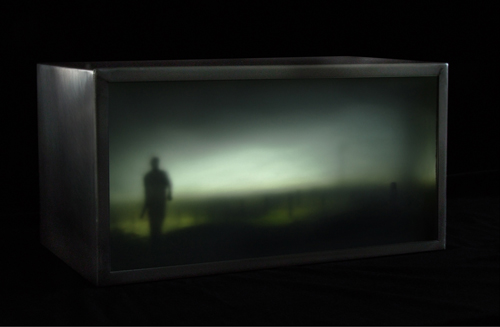
The artist’s current series, whitewash, is decidedly political in
content. In each of these beautiful
snow-scapes, the debris and reminders of death are only partially hidden from view. It is an anti-war statement, but is
made in a way that “those who supported
the war can look at it and appreciate it.” Jeff employs a Taoist approach in the assertions he makes
within the work. Being very conscious of the growing polarization of politics and society in the US, his work is an empathetic communication of his ideals. While consciously making them as beautiful as possible, it allows for the ugly message to be put across in a more digestible way. In doing so, he hopes for the audience to appreciate the duality without judgment. In his own words, the work alludes to “the way in which we all try to whitewash something of ourselves, as individuals and as nations. It’s a human need to see oneself as someone who is good on some fundamental level, so that tension between the desire to present ourselves as good, is in conflict with the knowledge we have of the bad things we have done.”
recognizes Tim Tate and Michael Janis of the Washington Glass School among those who inspired and supported
him early on in his glass career. “Tim
Tate was there at the beginning, being
able to share a studio with him as he set
up the Washington glass school opened so
many doors, and the fact that he was so
interested in taking glass and pushing it
forward in terms of content was significant,”
Zimmer says.
Master’s to allow for a more focused and full-time
exploration of the technique. His
research of programs on both sides of the
Atlantic lead him to the Edinburgh
College of Art (now part of the University
of Edinburgh). The program, then lead by
Ray Flavell and Alec Galloway, was one of
few that offered Architectural glass on a
full time basis. It was here that his
ideas on perception and ambiguity developed,
which remain strong themes in his work to
date. Upon graduation, he was offered a
position as Artist in Residence, in
addition to teaching architectural and stained
glass to part-time students in conjunction
with the college’s Office of Lifelong
Learning Program. Jeff still runs the
part-time stained glass course and is presently
a Temporary Lecturer in Glass within the
main Glass Department.
A residency at North Lands Creative Glass in 2006 brought about another shift in artistic direction for Jeff. Having arrived in this remote landscape at the Northern tip of Scotland with a very cerebral proposal for new work, it proved difficult to resolve. However, he couldn’t help but respond to
the 360-degree horizon he found there,
which his first landscapes. The impetus
of the series was in part, “to capture
that elemental feeling of such vast space.”
Previous to that opportunity, Jeff’s work
had been strongly figurative, but as I
found out, his military father painted landscapes
as a hobby. Jeff’s work does stem from a
very different emotional place, but even
so, perhaps it is no surprise that he has
been drawn to the genre.
wrong, the work retains an element of
ambiguity. As for the frames, those are
scoured from second-hand shops and
auctions. The more ostentatious and
grandiose, the better. As a classic
marker of important and perhaps
conservative art, Jeff conciously utilizes them to undermine the cosy nature that the patina of time gives to older art, implying a feeling of safety.
Scottish Independence Referendum is coming up in 2014. Where, as the artist notes, “We will have the whole country deciding how we define ourselves… Who is in? Who is out?”
a quarterly basis. His work is represented by The wexler Gallery in Philadelphia and Maurine Littleton Gallery in washington, DC a quarterly basis.