
The GSOI caught up with Laura Quinn, a young emerging Irish designer who has had an amazing start to 2020. After an invitation from North Lands Creative, Quinn exhibited at Collect in Somerset House in London. This is an important achievement as Collect is renowned worldwide as one of the premier art fairs dedicated to craft and design. In her own words Quinn spoke of the enormity of participating in Collect.
“The opportunity to position my work, and the practice I have worked hard to develop, alongside other wonderful makers has been reaffirming and inspiring. The support I received from North Lands Creative to bring my work to an audience this large and diverse has been amazing.”
Initially graduating from NCAD with a degree in Glass Design and the History of Art and Design in 2015, Quinn has recently completed a Masters Degree in 3D Design Crafts from Plymouth College of Art. During this period her design process has had two significant focal points.
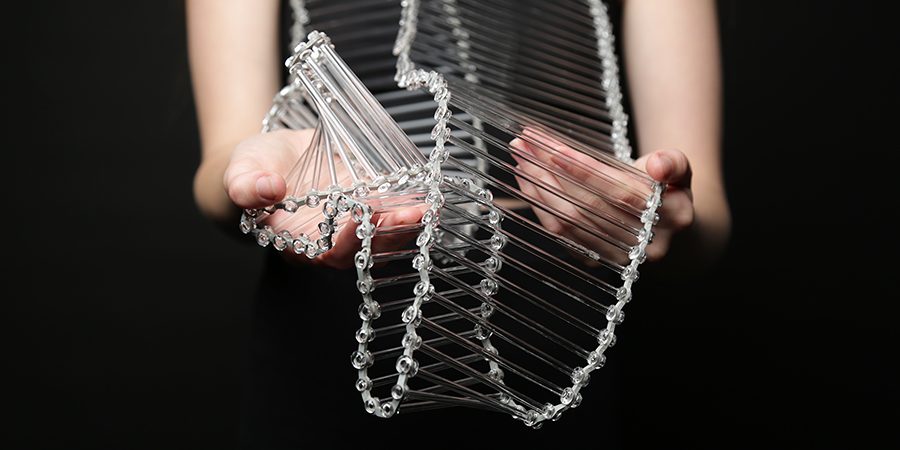
Engaging with concepts established during her studies at NCAD Quinn focuses on making her designs, modular and interchangeable. The modular nature of her glass supports the modern ethos of designing with an awareness of new design possibilities and environmental challenges. Components are interchangeable and can be repaired, recycled or redesigned. Throughout her masters she began utilising digital design processes in combination with traditional glass making to enable a co-design process. Using the traditional processes of lampworking and glassblowing combined with 3D printing and water jet and laser cutting this young artist is propelling glass from the realm of traditional craft into the modern design age.

Quinn focuses her design process on human centred design and engineering. This allows glass, a fragile material, to become malleable. She uses the possibilities of 3D printing to navigate the difficulties in joining glass pieces. In particular this can be seen in Quinn’s wearable glass designs, where individual glass components are in motion both individually and as a whole. This attention to the engineering detail leads to the development of a relationship between the glass and the owner. Developing the perfect joining components can be an ever evolving process. In a seminal experience whilst studying under Dr. Caroline Madden at NCAD Quinn was advised:
“Do not design to your technical abilities, design to your maximum creativity. The skills will come at some point, and you will always be able to return to your design sketch book for inspiration for a lifetime.”
A prime example of this evolving design process is a glass neckpiece which Quinn initially designed in 2015, developing the rubber joining components in 2016 and finally designing a 3d printed ball and socket solution whilst completing her masters.
Throughout her masters Quinn has also focused her practice on challenging both our perceptions of glass as a material, and gallery etiquette. Through continuing research on The Human Interface with Glass, she aims to redefine how we interact with glass. While exhibiting at Collect Quinn encouraged the audience to touch and interact with the glass. The ‘Flop Bowl’ made out of laser cut silicon combined with hundreds of individual lampworked glass components captured the imagination of the audience.
“When I insisted they get their hands on it the oohs and ahhs were audible.”

This small action redefines the audience expectations of both gallery etiquette, and how we interact with perceived fragile materials such as glass. The results of this inquiry process into The Human Interface with Glass will be presented by Quinn at the Glass Art Society Conference in Sweden in May 2020.
Quinn is a young designer with passion and a keen sense of the changing design landscape and we look forward to seeing her continued development.
You can view more of Laura’s glass work on her website and through social media.
Instagram: Laura Quinn Design
Facebook: Laura Quinn Design